
“ सेवा, सुरक्षा और समाधान ”
“ सेवा, सुरक्षा और समाधान ”
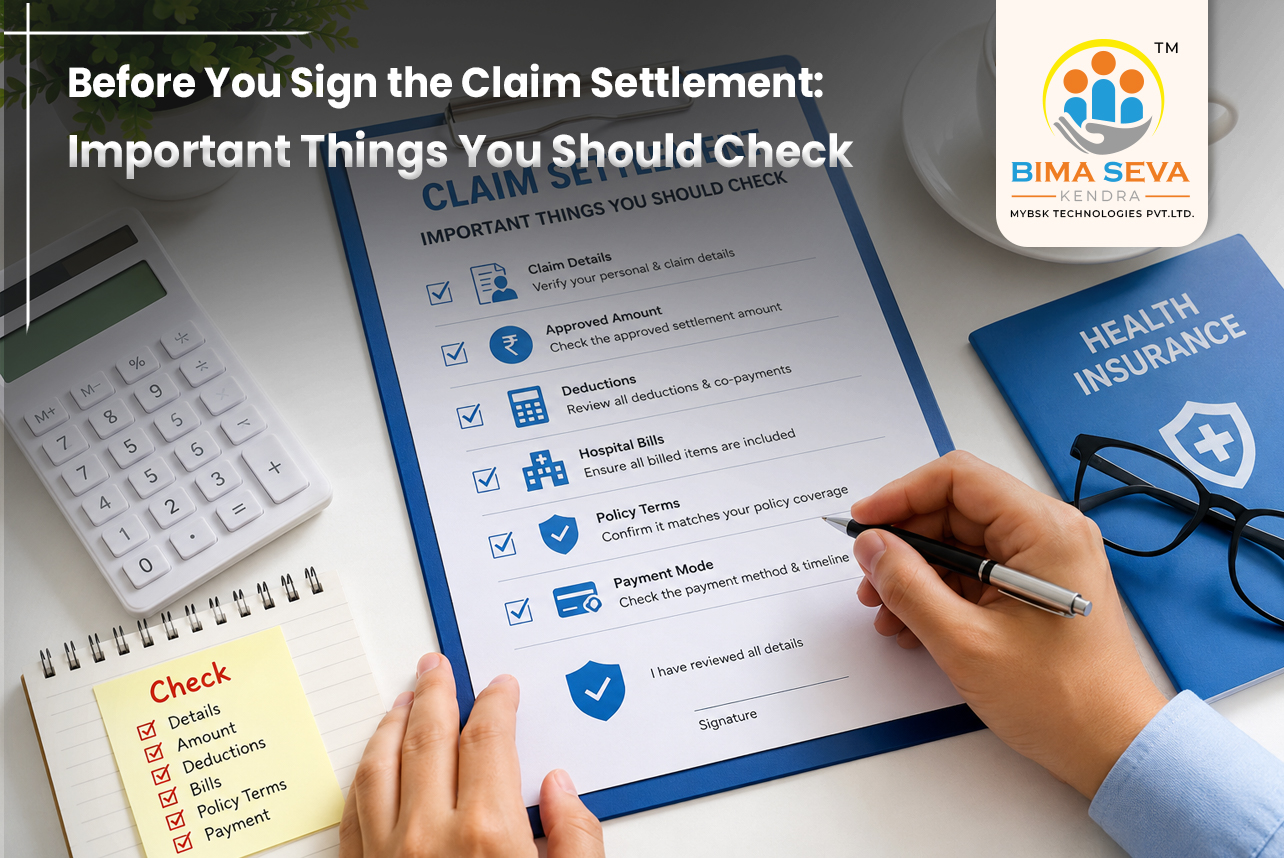
Before You Sign the Claim Settlement: Important Things You Should Check
After weeks of submitting documents, answering queries and following up with the insurer, you finally receive the message you have been waiting for:
“Your claim has been approved.”
Relief comes first.
At this stage, many policyholders are tempted to sign the settlement documents immediately and move on. That is understandable. After dealing with a lengthy claim settlement process, nobody wants another round of paperwork.
However, a settlement document is more than a formality. Before signing, it is worth spending a few minutes understanding exactly what has been approved, what has been deducted and what you are agreeing to.
Here is what to check.
1. Start With the Amount, Not the Signature
Look at the amount mentioned in the settlement letter or offer. Then compare it with the amount you originally claimed and the amount you calculated you should have gotten after deductions.
For example, suppose you submitted a claim for ₹3 lakh and the insurer has approved
₹2.25 lakh. Do not assume that the remaining ₹75,000 has simply been “cut.”
There may be several reasons for the difference:
- Expenses that are not covered under the policy
- Applicable deductibles
- Co-payment
- Sub-limits
- Room-rent restrictions
- Expenses exceeding policy limits
- Other deductions permitted under the policy terms
The important part is that you should be able to understand how the final figure was calculated.
A settlement amount should not feel like a number that appeared out of nowhere.
2. Ask for the Deduction Details
If the settlement is significantly lower than your claim, look for the detailed calculation.
A good settlement review should answer three basic questions:
- What did I claim?
- What amount was considered admissible?
- Why was the remaining amount not payable?
Suppose the insurer has deducted ₹18,000 for non-payable expenses and another ₹20,000 because of a policy sub-limit. Those deductions can then be checked against the policy terms.
This is very different from simply seeing:
Claimed: ₹3,00,000
Approved: ₹2,62,000
The second version tells you the outcome. The first approach helps you understand it.
3. Compare the Settlement With Your Policy
You do not necessarily need to read every page from beginning to end. Look specifically at the sections relevant to the claim.
Check:
- Sum insured
- Deductibles
- Co-payment
- Sub-limits
- Room-rent limits
- Waiting periods, where relevant
- Exclusions
- Specific conditions attached to the treatment or benefit
For example, if ₹50,000 has been deducted because of a sub-limit, find the relevant sub-limit in your policy and see whether it actually applies to your treatment.
The question is not whether the deduction looks large. The question is whether the deduction is supported by the policy’s terms.
4. Do Not Confuse a Short Settlement With Claim Rejection
A claim rejection means that the insurer has declined the entire claim.
A partial/short settlement means that the insurer has accepted liability for at least part of the claim but has not approved the entire amount requested.
That distinction matters because your response should depend on what has actually happened.
If only certain expenses have been disallowed, ask why those particular expenses were excluded.
If the entire claim has been rejected, ask for the reason and the specific policy provision relied upon.
In both situations, keep the written communication safely stored. It may become important if you later need to raise claim rejection-related issues.
5. Check Whether the Documents Match
Before accepting the settlement, compare the basic details in the settlement letter with your claim documents.
Check the:
- Policy number
- Claim number
- Patient or insured person's name
- Hospitalisation dates
- Treatment details
- Amount claimed
- Amount approved
A small clerical error may not necessarily affect the claim, but identifying it early is much easier than trying to correct the record later.
-
Be Careful With Verbal Explanations
Imagine you call customer care and ask why ₹30,000 was deducted.
The representative says, “That amount is not payable under your policy.”
That may be the explanation, but it is still vague, and it is still reasonable to ask: “Could you please tell me which policy clause applies in writing?”
Written explanations are much easier to understand, compare and preserve than a conversation that ends as soon as the call does.
This is especially useful if you later need to escalate an insurance claim-related issue.
-
Do Not Sign Simply Because You Are Tired of Following Up
This may be the most human part of the entire process. After weeks of waiting, a policyholder may think:
“Fine. At least they are paying something. Let me just finish this.”
That reaction is completely understandable. We admit that. But frustration can make people overlook details they would normally question.
If the amount is lower than expected, take some time to understand the reason, or contact a Subject Matter Expert to help ease the process. If the explanation is satisfactory and consistent with the policy, you can proceed with greater confidence.
If something does not add up, ask questions before signing.
-
What If You Disagree With the Claim Settlement?
Start with the simplest step: understand the calculation.
Ask the insurer for clarification on the disputed deduction and identify the relevant policy provision. If the response does not resolve the concern, you can use the insurer's grievance redressal mechanism and retain copies of your correspondence.
Many questions can be resolved simply by obtaining the right document or clarification.
However, if the issue becomes more complicated — for example, if the deduction appears inconsistent with the policy, repeated representations have not resolved the matter, or the dispute now requires claim rejection services — a professional review of the documents may help you understand what options are realistically available.
That review should begin with the facts rather than assumptions about who is right or wrong.
9. A Simple Five-Minute Check Before You Sign
If you are in a hurry, remember these five questions:
|
Check |
What You Should Know |
|
Amount |
How much was claimed and how much was approved? |
|
Deductions |
What exactly was deducted? |
|
Policy |
Which terms justify those deductions? |
|
Settlement wording |
What are you agreeing to by signing? |
|
Next step |
What can you do if you disagree? |
If you can answer all five, you are in a much better position to make an informed decision.
Final Word
Insurance is complicated enough without signing something you did not fully understand.
And so when the next steps seem unclear, ask for help.
SMEs can review the available documents, help identify where the disagreement actually lies, explain the relevant process and, where appropriate, help you understand the available escalation options.
That is often enough to turn a confusing settlement into a question with a clear answer.
And sometimes, that is all a policyholder needs.
© 2026 MYBSK All Rights Reserved. Designed By SKALY INFOTECH PVT.LTD.