
“ सेवा, सुरक्षा और समाधान ”
“ सेवा, सुरक्षा और समाधान ”
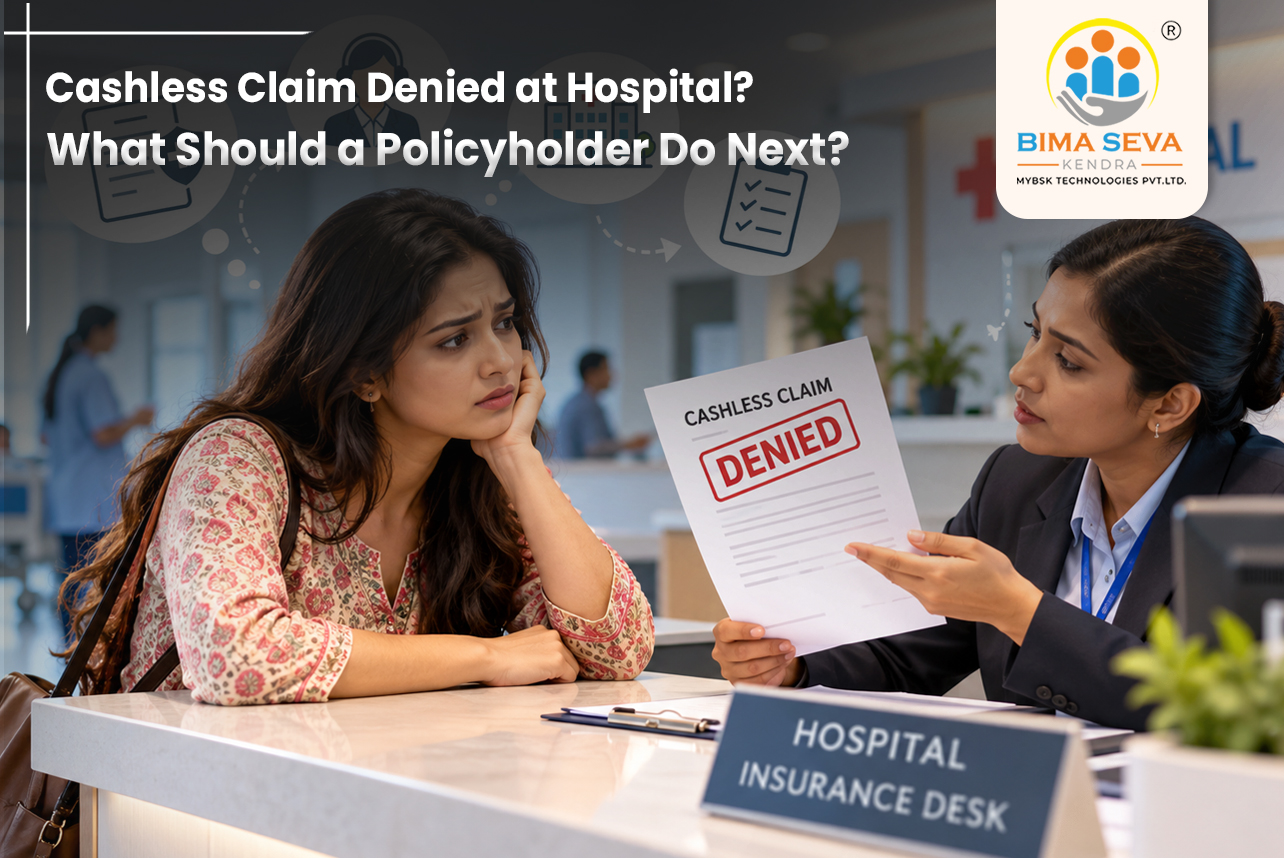
Cashless Claim Denied at Hospital What Should a Policyholder Do Next
If you are reading this, then someone you love needs medical care. There may already be enough to think about: the diagnosis, the treatment, the doctor, the medicines, the next test.
And a cashless request denial is the last thing you need to deal alone.
So, let Bima Seva Kendra take something off your plate, because we know how hurdles like this make everything more frightening all at once.
Take a breath. We’ve got you.
A cashless denial does not necessarily mean that your insurance claim has been rejected. It means the insurer or its authorised Third Party Administrator (TPA) has not approved the hospital's request for cashless treatment at that stage. What happens next depends on why the cashless request was denied.
Here is what you can do.
-
First, Find Out Why the Cashless Request Was Denied
Do not settle for being told only, “Insurance has rejected it.” You never know if a clarification can turn the tables.
Ask the hospital insurance desk or TPA for the specific reason for denial, preferably in writing. There can be several reasons, including:
|
Possible reason |
What it may mean |
|
Treatment was not covered |
The treatment falls under an exclusion or other policy restriction. |
|
Waiting period applies |
The policy may have a waiting period for the particular illness or treatment. |
|
Pre-existing disease concern |
The insurer may need to examine whether the current treatment relates to a condition existing before the policy began. |
|
Policy or coverage issue |
There may be an issue concerning policy validity, a lapsed insurance policy, available coverage, or the terms of the policy. |
|
Hospital-related issue |
Cashless treatment is available through the insurer's network of hospitals. Treatment at non-network hospitals can cause a request rejection. |
|
Insufficient information |
The insurer/TPA may need additional medical information or documents before deciding. |
|
Treatment or admission does not meet policy conditions |
The insurer may be questioning the medical necessity, eligibility, or other terms applicable to the claim. |
The important thing is to identify which reason actually applies to your case rather than assuming that the word “denied” means the end of the story.
-
Cashless Request Denial Is Not the Same as Claim Rejection
A cashless facility allows the insurer to pay the hospital directly, to the extent the treatment is authorised and covered under the policy. It is a facility where payment is made directly to a network provider after pre-authorisation is approved.
If cashless authorisation is denied, you should therefore ask:
“Has only the cashless facility been denied, or has the claim itself been rejected?” These are not necessarily the same thing.
Depending on the circumstances and policy terms, a policyholder may still be able to pursue the claim through reimbursement after paying the hospital, particularly where the treatment itself is otherwise covered.
That is why it is important not to leave the hospital desk with only a verbal “No.” Find out what has actually been decided.
-
What Should You Ask the Hospital Insurance Desk?
When you are already worried about a sick family member, remembering what to ask can be surprisingly difficult.
Keep it simple. Ask these questions:
- What exactly is the reason for the cashless denial?
- Can I get the denial or query in writing?
- Has the insurer rejected the claim itself, or only denied cashless authorisation?
- Were any additional documents or medical reports required or requested?
- Can the hospital submit the required information and ask for a reconsideration, if applicable?
- If cashless treatment remains unavailable, can I proceed with treatment and later file a reimbursement claim under my policy?
If there is a delay, ask the hospital or TPA:
“When was the cashless request submitted, and what is its current status?” Write down the answers.
-
Do Not Stop Necessary Medical Treatment Because of Panic
If the patient needs urgent medical attention, the priority is the patient's health.
A cashless denial can be frightening, particularly when the family suddenly starts worrying about arranging money. But the insurance decision and the medical decision are two different matters.
Speak to the treating doctor and hospital about the treatment that is medically required. At the same time, ask the insurance desk what options are available for payment and claim processing.
If you have to make a payment yourself, keep every document.
That includes:
- Hospital bills
- Discharge summary
- Prescriptions
- Diagnostic reports
- Investigation reports
- Pharmacy bills
- Payment receipts
- Doctor's notes
- Insurance correspondence
- Cashless denial letter or authorisation response
- Any additional documents requested by the insurer or TPA
Do not throw away any documents thinking they are irrelevant. They may become important if you later pursue reimbursement or challenge the decision.
5. Check the Policy When Time Allows It
It is understandable to feel angry when a cashless request is denied. But the reason matters. Take a few minutes, if possible, to check the policy document or Customer Information Sheet for the relevant terms.
Look particularly for:
- Waiting periods
- Exclusions
- Sub-limits
- Co-payment
- Room-rent restrictions
- Pre-existing disease provisions
- Coverage limits
- Network hospital conditions
- Specific conditions attached to particular treatments
IRDAI itself advises policyholders to understand restrictions before buying the policy.
This does not mean that every denial is automatically correct. It simply means that the reason for the denial needs to be compared with the actual wording of the policy.
6. If You Believe the Denial Is Incorrect
This is where it helps to slow down before making an emotional decision.
Read the reason for denial carefully.
For example, suppose the insurer says that a particular treatment is excluded. Check whether the policy actually contains that exclusion and whether it applies to the treatment being provided.
Or suppose the denial refers to a waiting period. Check when the policy began, what waiting period applies, and whether the condition in question actually falls within it.
If the reason does not appear to match the policy documents, you can raise the matter with the insurer through its grievance redressal mechanism and ask for a review of the decision.
A denial should not leave you wondering what happened.
7. Where Can Bima Seva Kendra Help?
When a family is dealing with illness, the hardest part is often not just the paperwork. It is trying to understand what the paperwork actually means while also caring for someone.
That is where Bima Seva Kendra (BSK) can provide a second set of eyes.
If you are facing insurance claim-related issues, BSK can help you examine the circumstances surrounding the denial, understand the relevant policy terms, organise the available documents and identify what needs to be communicated to the insurer.
Where appropriate, professional assistance can also help you prepare a structured representation or grievance based on the documents and policy terms.
The purpose of getting help is to understand the decision, identify whether there is a reasonable basis to question it, and present your case properly when there is.
That clarity can matter enormously when you are already carrying enough worry.
Conclusion
A hospital admission can make an insurance policy feel very different from the document you bought months or years ago.
When everything is going smoothly, the policy may be just another file in your email.
When someone is ill, suddenly every clause matters.
If you are currently sitting in a hospital corridor trying to figure all of this out, remember one thing: a cashless denial is a financial and administrative problem. It is not a verdict on your loved one's treatment, and it does not automatically mean that your entire insurance claim is over.
Take it one step at a time. Bima Seva Kendra is just a call away.
© 2026 MYBSK All Rights Reserved. Designed By SKALY INFOTECH PVT.LTD.