
“ सेवा, सुरक्षा और समाधान ”
“ सेवा, सुरक्षा और समाधान ”
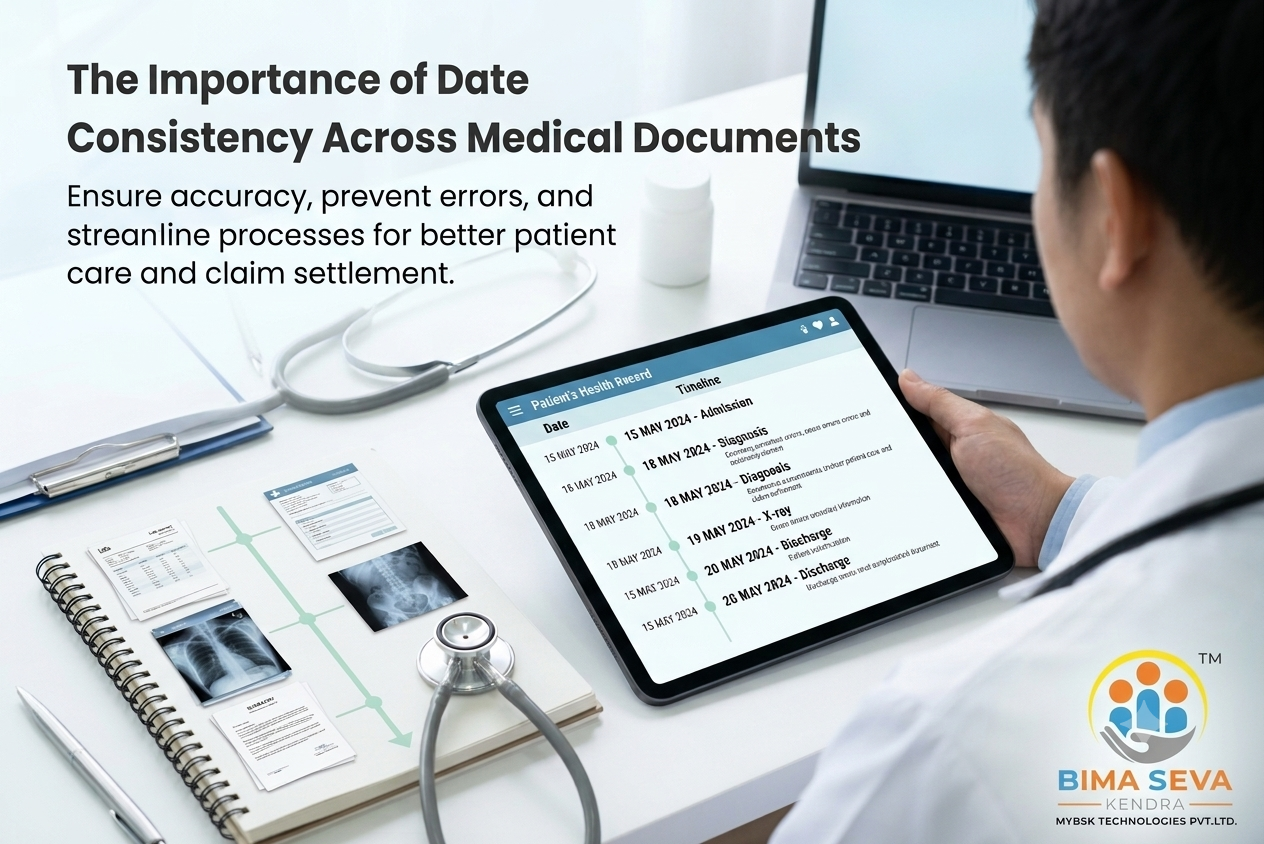
The Importance of Date Consistency Across Medical Documents
“Why do dates matter if my documentation is complete?”
The simplest answer is - The calendar never lies. People sometimes do. Paperwork sometimes does too.
One of the first things that can give away a claim as insurance fraud is not the diagnosis, the prescription, or even the hospital invoice.
It's the timeline.
That single timeline quietly connects every stage of your medical journey—from your first consultation to your final discharge. When every document supports the same chronology, the claim settlement process becomes clearer and more efficient.
When important dates don't align, even genuine claims may require additional verification before they can move forward.
That is not to say that every mistake automatically makes a policyholder a fraud in the insurer’s eyes. More often, there are simple administrative mistakes, typing errors, or documentation oversights. Understanding why they matter can help policyholders avoid unnecessary insurance claim-related issues and appreciate why insurers examine timelines so carefully.
1. Why Are Insurance Companies So Particular About Dates?
The short answer? Because insurers need to look for red flags too.
Insurance works like a shared emergency fund. If everyone chips in ₹10, there is enough to pay for one person's unexpected ₹1,000 hospital bill. Insurers NEED to scrutinise every claim settlement very carefully to protect this emergency fund from fraud.
Think about the documents that shape the biggest moments of your life.
A birth certificate. A passport. A property registration. A marriage certificate. A court order.
Every one of these documents depends on one thing: An accurate timeline.
Insurance is no different because medical treatment happens in a sequence too.
Symptoms appear. Doctors examine the patient. Investigations are conducted.
Treatment begins. Recovery follows. Discharge takes place. The claim is submitted.
When every document reflects that sequence consistently, it becomes much easier to understand what happened and assess the claim fairly.
2. Dates Do More Than Mark Time—They Establish Evidence
A common misconception is that dates are simply administrative details.
In reality, they help establish several important aspects of a claim, including:
- Whether the policy was active on the date of treatment.
- Whether waiting periods had been completed.
- Whether treatment followed the reported diagnosis.
- Whether investigations reasonably supported the procedure performed.
- Whether documents were submitted within applicable timelines where required under the policy.
Without an accurate chronology, even experienced claim assessors may be unable to understand the complete medical picture.
That is why timelines are never treated as a formality. They are part of the evidence.
3. When One Incorrect Date Can Raise Questions
It is important to remember that a date mismatch does not automatically mean something is wrong. However, it usually raises questions that need to be answered before the claim can be assessed.
Here are a few examples.
A diagnostic report appears after the surgery it was meant to justify: Sometimes reports are uploaded late or printed on a different date. Without an explanation, the sequence may appear confusing.
The admission date differs across documents: The hospital bill mentions one date, while the discharge summary records another. Even if it is a simple clerical error, clarification may become necessary.
The claim form contains an incorrect treatment date: Mixes with other patients or maybe even an incorrect update are rare, but they do happen. Especially when hospitals have surge seasons like festival season or monsoons. A single typing mistake can create avoidable insurance claim-related issues.
Older medical reports are attached by mistake: Patients frequently carry previous investigations for reference during treatment. Accidentally including an older report without context may create confusion about the actual timeline.
This often happens when forms are completed in a hurry. Mistakes are very human, especially during vulnerable times when priorities are people and not paperwork.
Which is why experts at Bima Seva Kendra advise policyholders to seek assistance in claim filing before complications arrive so that the policyholder can focus on the most important part— Healing.
4. Date Consistency Protects Everyone—Not Just the Insurer
Many people assume insurers examine timelines because they are looking for reasons to reject claims.
The reality is more balanced. Accurate timelines help protect the integrity of the insurance system itself.
They discourage fraudulent claims. They reduce the risk of altered documentation. They help ensure that benefits are paid under the correct policy terms. Most importantly, they also protect honest policyholders through the protection of the funds required to settle claims.
When your medical records consistently support your treatment journey, they become stronger evidence of what actually happened in case malpractice happened on the hospital or the insurer’s side.
Good documentation safeguards genuine claims just as much as it helps identify irregular ones.
5. What Do The Experts At Bima Seva Kendra Say?
At Bima Seva Kendra (BSK), we have seen over 15000 cases, with nearly ₹ 35Cr+ Claims under consideration. And with 100+ cumulative years in insurance, we see the person behind the policy.
Legal and insurance jargon is very hard to understand for the general public. We understand that. And so we simplify the process while collaborating with and educating policyholders throughout the claim journey.
Our subject matter experts carefully reconstruct that story through its chronology.
- When did the symptoms begin?
- When was the patient admitted?
- When were investigations performed?
- When was treatment provided?
- When was the patient discharged?
- Do all the supporting documents reflect the same sequence?
These questions often provide valuable context before any conclusions are drawn.
This approach is not about looking for mistakes. It is about ensuring that the documentation accurately represents the medical journey and supports a fair claim settlement process.
Because insurance paperwork is not simply a collection of forms. It is evidence.
6. A Simple Timeline Check Every Policyholder Can Do
Before submitting your claim, spend just a few minutes reviewing the dates across your documents.
Ask yourself:
- Does the admission date match everywhere?
- Are investigation reports consistent with the treatment timeline?
- Do the discharge summary and hospital bill reflect the same period of hospitalisation?
- Have I entered the correct treatment dates in the claim form?
- Are all attached medical records relevant to this episode of treatment?
This small review can help reduce avoidable delays and prevent unnecessary requests for clarification later.
Conclusion: Every Date Has a Purpose
Calendars don't approve insurance claims. People do.
But people make informed decisions using the evidence placed before them. In insurance, dates are far more than numbers printed at the top of a page.
They establish chronology. They provide context. They strengthen credibility.
Most importantly, they help ensure that genuine claims are understood exactly as they occurred.
Sometimes, protecting your claim settlement begins with something as simple as making sure every document is telling the same story—on the same calendar.
© 2026 MYBSK All Rights Reserved. Designed By SKALY INFOTECH PVT.LTD.